Retro cars seized Varna on the occasion of the seaside capital. 17 antique cars set off today on the parade from City Hall on city streets.
After Varna cars will pass through Aksakovo Dolishte, Balchik, Kavarna and tomorrow will again finish in the seaside capital. The parade involved cars in Varna, Sofia and Loznica. One of the most attractive among them is "Citroen 2CV", a copy of the car from the cult film "The policeman married" by Louis de finesse. Mother and daughter did participate with pure white Mini Cooper.In the center of today Aksakovo cars will compete in the master drive around cones. Winners will be awarded cups and certificates.
Traditionally, the rally is held on the Day of the seaside town - 15 August. The first launch is set in the far 1938, the race organizers comment by retro-Road Club Varna. Since then, the date and the first pictures from the parade of old cars in the city, which can be seen in the photo collection of Lambrin Sotirov.
Showing posts with label Citroen. Show all posts
Showing posts with label Citroen. Show all posts
Sunday, October 10, 2010

Top 3 Retro Cars

Nowadays we can see a growing tendency of retro-cars popularity. People are interested more and more in these retro modern things… So here we are glad to present to your attention the best three retro-cars, which are at the same time very popular. Factually, there is a great number of terrific retro-cars, but we cannot present them all to you. Among these models e can name such as 1962 Corvette convertible, Jaguar E-Type and Aston Martin DB5 and many others.Do you guess what the secret of their popularity is? First of all it’s simplicity, though some of them have been flawed technically or suffered from different variations. And you know, this list is only our vision and there are many marvelous retro cars for you to choose. Still, look here please.
Wednesday, August 4, 2010
Berliet

Marius Berliet started his experiments with automobiles in 1894. Some single cylinder cars were followed in 1900 by a twin-cylinder model. In 1902, Berliet took over the plant of Audibert & Lavirotte in Lyon. Berliet started to build four-cylinder automobiles featured by a honeycomb radiator and steel chassis frame was used instead of wood. The next year, a model was launched that was similar to contemporary Mercedes. In 1906, Berliet sold the licence for manufacturing his model to the American Locomotive Company Before World War I, Berliet offered a range of models from 8 CV to 60 CV. The main models had four-cylinder engines (2412 cc and 4398 cc, respectively) and there was a six-cylinder model of 9500 cc. A 1539 cc model (12 CV) was produced between 1910 and 1912. From 1912, six-cylinder models were made upon individual orders only. In 1917, Berliet started to build trucks for the French Army. The company produced 40 trucks a day. After the war, 12 CV (2613 cc), 15 CV (3308 cc) and 22 CV (4398 cc) were produced. A new 7 CV (1159 cc) appeared in 1924. New six-cylinder models followed in 1927. From 1933, only four-cylinder models (1600cc and 2000cc) were offered. The last Berliet sedan from 1936 was Berliet Dauphine propelled by a 2-litre engine and using the body of a Peugeot 302B with a custom made hood and radiator grille. Passenger car production ceased in 1939 and after World War II, the company produced trucks only. Berliet is famous for building the largest truck in 1957, the T100 with 600 hp (447 kW). It was designed in 10 months at the factory in Courbevoie, outside of Paris. In August 1967, it was reported that Berliet had been taken over by Citroën, Berliet share holders receiving Citroën shares in return for their Berliet stock. In 1966, Berliet's final year as an independent, they had produced approximately 17,000 units. Following the take-over the merged company stated that Citroën-Berliet would command 58% of France's market for commercial vehicles above 6 tons.Citroen itself had been owned by Michelin since 1934 following a cash crisis of its own. By this time, Michelin owned both Citroën and Berliet. However, after the 1973 oil crisis, Michelin decided to divest itself of these two companies in order to concentrate on its tire business. Thus, in 1974 Berliet was sold to Renault, while Citroën was sold to Peugeot. Renault then proceeded to merge Berliet with Saviem to form RVI. After the merger, the Berliet name was phased out and another French marque came to an end.
Tuesday, August 3, 2010
Citroen Visa sport

Visa Super X 1980-1982
The Super X has only been on sale from late 1980 until 1982. Only a limited number were built and it is now a rare car. This model was the 'performance' model, the 1.2 engine being almost identical to the 1.1, except for different bore and stroke with correspondingly different carburettors, distributors and so on.
To promote the Visa, a 'Trophйe Visa International' competition was established in 82. The Super X was redesigned for this purpose and the model named Visa Trophйe.
 Visa Trophйe 1982-1983

To promote the quality of the Visa, Citroen asigned Guy Verrier to establish a 'Total Trophйe Visa International' competition in 1981 with Group V Visa's. The Super X was redesigned and the model named Visa Trophйe. To set even higher standards of performance, in 1982 the Trophйe was homologated as a Group B (class up to 1300cc) car of which 200 cars (82-83) were built in total. The Trophйe was a great success and won many rallies. The engine of the Super X was enlarged to 1299 cc, fitted with 2 carburettors. It produced in this form 100-150 bhp.
One of the prototypes for the Trophйe was designed by Lotus. Guy Verrier introduced a new formula every year. In 1984, the Citroлn-Total-Michelin Women's Trophy attracted thousands of women. The Marque competed in Kenya, Mille Lacs, San Remo and Monte Carlo.

 Visa 1000 Pistes 1983-1984
The four-wheel drive Visa Mille Pistes was meant as a follow-up to the succesfull Trophйe Visa International. Citroen released the Mille Pistes end 1983 as a Group B car, and 200 were built. The Mille Pistes was even more succesfull than the Trophйe. Even nowadays, the Mille Pistes competes in many rallies!
The car was based on the GT, but with 4 (!) carburettors instead of 2 and four-wheel drive. Two round headlights, extended wings, and a special badge in the grille: two Citroen chevrons with an 'X' in
 Visa GTi 1985-1988
The successor to the GT. With its new generation 1.6 105 bhp engine with fuel injection, it was capable of astonishing performances. The interior was pretty civilised, but with a sporting dashboard and good seats. Lowered suspension, close-ratio 5-speed gearbox, alloy wheels, and subtle details like extended wings, spoilers and twin round halogen head lights. For 1987 the power was increased to 115 bhp.

original source: http://www.citroenvisa.net/vindex.htm
Visa
The Visa was launched at the Paris Salon in 1978 to replace the Ami 8. The development of this new compact car started life in the early 70's as 'Projet Y2'. Initially using the Fiat 127 platform, once the rapprochement with Fiat ended, the project was redefined. It now incorporated a genuine Citroлn floorpan with a torsion bar suspension. The original design brief called for the use of either the air-cooled 2 cylinder or the air-cooled 4 cylinder engine from the GS.

Projet VD' or 'Voiture Diminuйe', as it was now called, addressed itself to the need for a small, robust, modern car. A number of styling exercises were undertaken but in 1974, Peugeot acquired Citroлn and the project was redefined (again) to incorporate the floor pan of the Peugeot 104, thereby permitting the use of the 104 engine and transmission.
Project VD eventually became three cars: LN(A), Visa and the closest to the original, the Axel which was built in Romania by Oltcit. The Axel comprises the original torsion bar suspension and lots of other original details. The LN and Visa use MacPherson struts at the front as in the Peugeot 104

Projet VD' or 'Voiture Diminuйe', as it was now called, addressed itself to the need for a small, robust, modern car. A number of styling exercises were undertaken but in 1974, Peugeot acquired Citroлn and the project was redefined (again) to incorporate the floor pan of the Peugeot 104, thereby permitting the use of the 104 engine and transmission.

Project VD eventually became three cars: LN(A), Visa and the closest to the original, the Axel which was built in Romania by Oltcit. The Axel comprises the original torsion bar suspension and lots of other original details. The LN and Visa use MacPherson struts at the front as in the Peugeot 104
Citroen DS
The evolution of the DS Although the DS (and ID) were manufactured during almost 20 years, they seem not to have changed very much during that time. There was only one really obvious and big change; starting from september 1967 (model year 1968) the DS and ID got a new front (fig. 3 below).
But if one looks a bit closer to all those DS/ID's, on a big Citroлn meeting for example, more (smaller) changes become obvious: In sept. 1959 the rear wings became a bit longer, in sept. 1962 the front changed (bumper, air-intakes), in sept. 1971 the door handles changed. If one looks at the interiors, different types of dashboards and a change of the shape and cloth of the seats in sept 1968 are observed.
A few other important changes are not easily seen : In sept. 1965 the DS got a completely new engine and gearbox, the ID followed on year later. Also changed in 1965 were the drive shafts, the front brakes and the way the wheels are mounted onto the hubs (5 bolts instead of just one central bolt).


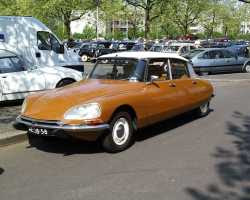
ID19 with second front
Model years 1963 - 1967
DSpecial with third front
Model years 1968 - 1975
Much more smaller changes can be found on closer inspection and if one takes the time to study the different parts books that Citroлn published over the years, one gets the impression that hardly any part of a 1955 DS19 is really indentical to the same part on a 1975 DS20.
original source: http://www.citroen-ds-id.com/
But if one looks a bit closer to all those DS/ID's, on a big Citroлn meeting for example, more (smaller) changes become obvious: In sept. 1959 the rear wings became a bit longer, in sept. 1962 the front changed (bumper, air-intakes), in sept. 1971 the door handles changed. If one looks at the interiors, different types of dashboards and a change of the shape and cloth of the seats in sept 1968 are observed.
A few other important changes are not easily seen : In sept. 1965 the DS got a completely new engine and gearbox, the ID followed on year later. Also changed in 1965 were the drive shafts, the front brakes and the way the wheels are mounted onto the hubs (5 bolts instead of just one central bolt).


ID19 with second front
Model years 1963 - 1967
DSpecial with third front
Model years 1968 - 1975
Much more smaller changes can be found on closer inspection and if one takes the time to study the different parts books that Citroлn published over the years, one gets the impression that hardly any part of a 1955 DS19 is really indentical to the same part on a 1975 DS20.
original source: http://www.citroen-ds-id.com/
Subscribe to:
Posts (Atom)